Frustrated with politics? Here's what new research says reconnects people
Key Takeaways
New national research shows most people feel shut out of politics
Frustration is the most common feeling people report about politics right now, across every demographic group
People who've lost trust in politicians still show up for their neighbors, coworkers, and communities at nearly the same rate as everyone else
The one factor that most reliably predicts whether someone becomes more politically active is having that sense of belonging somewhere
Minnesota's caucus system was built to keep politics in the hands of the people, and foster that sense of belonging
A recent national survey found that 77% of Americans feel at least some disillusionment about their political power and their outlook for the future. Within that group, researchers identified a narrower segment — about 35% of adults, tens of millions of people — who combine that disillusionment with deep distrust in institutions and elected officials. Researchers call this group "the disaffected."
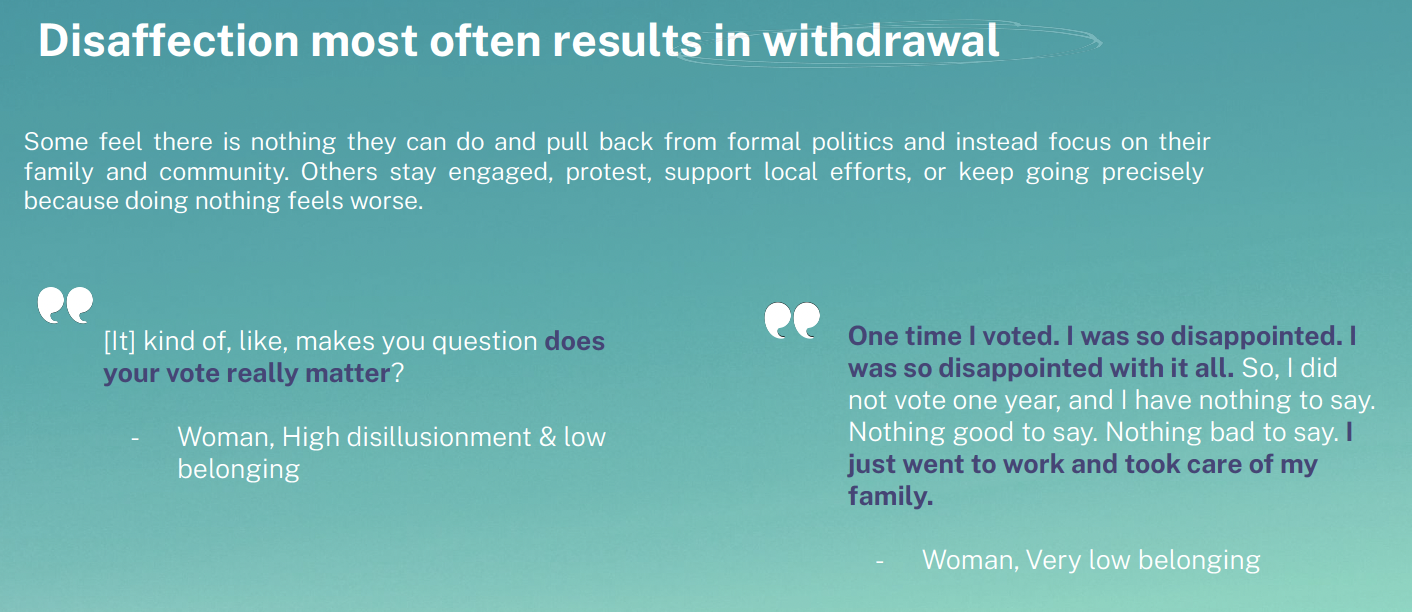
The same research also determines what predicts whether someone in that group becomes more politically active again. The strongest predictor was belonging, which outweighed trust, hope, and even how bad things currently feel.
That distinction matters for a state like Minnesota, which has its own long history of civic participation, and its own answer to the belonging question.
Disaffected doesn’t mean disengaged
It would be easy to assume that someone this frustrated with politics has simply stopped participating in civic life altogether. The data says otherwise.
Disaffected people do vote less. Only 41% of the disaffected say they voted in the last election, compared with 48% of the overall population. But nearly every other measure of civic and political action tells a different story.
The disaffected are just as likely to
Talk to a friend about a political issue
Search online for political information
Share something political on social media.
And they're actually more likely than the general population to
Sign a petition
Boycott a product over a political issue
Help someone fill out paperwork for benefits or government help.
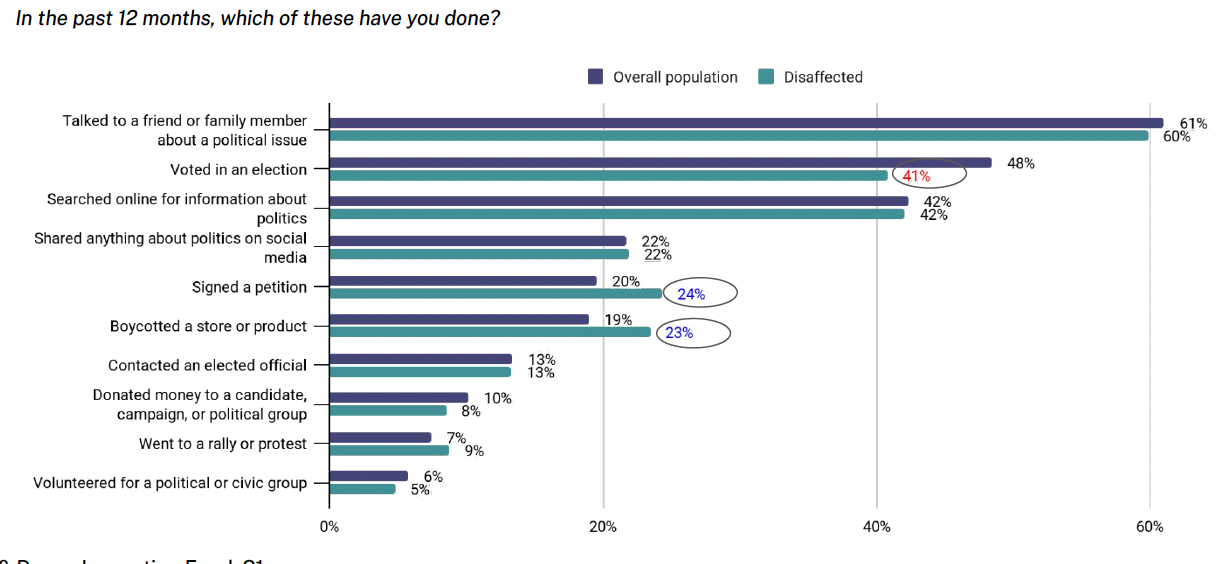
In other words, the energy hasn't disappeared, it’s simply gone somewhere formal politics isn't currently reaching.
What actually moves someone from frustrated to involved
Bridging that gap starts with understanding what predicts involvement in the first place. The researchers tested a long list of factors — trust, hope, income, political knowledge, news consumption, disillusionment — against how many political and civic actions someone actually took.
One factor stood out from the rest: belonging. Moving from the lowest level of belonging to the highest was associated with nearly five additional political actions and a 25% increase in the likelihood someone would vote in this year's midterms. Trust and disillusionment, by comparison, didn't move the needle nearly as much once belonging was accounted for.
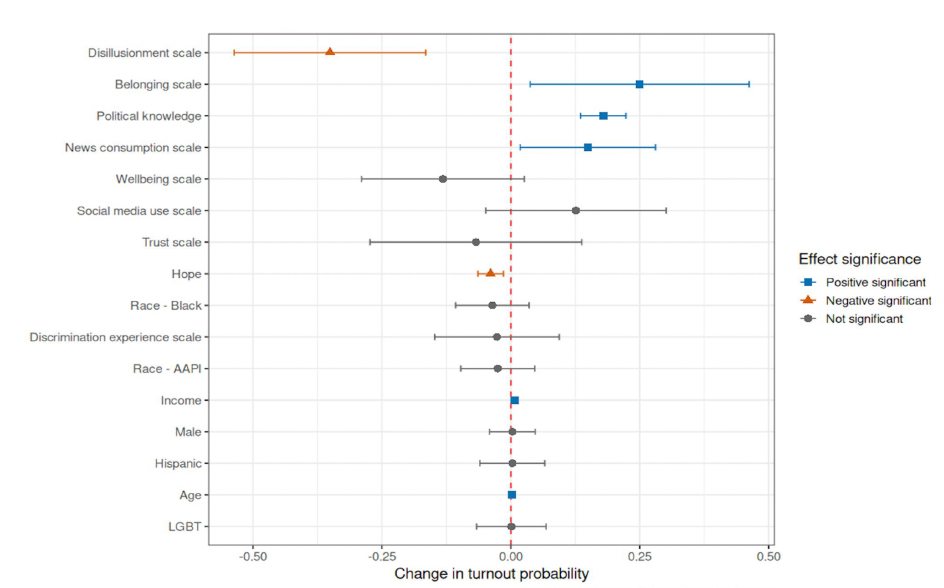
That tracks with what participants said directly in the focus groups. People described belonging as feeling safe, accepted, and connected to others who share their interests or their struggles — not as agreement on politics. And even among the most disaffected, 58% said they'd like to feel more connected to their community, even though their current levels of connection are lower than average.
How Minnesota's civic culture offers a model for rebuilding political belonging
Minnesota consistently ranks among the highest states in the country for voter turnout, a reflection of a broader habit of local civic involvement, from township meetings to volunteer fire departments to neighborhood associations. The core finding in the report — that people re-engage through people they already know, in places that already feel familiar — is a reality Minnesota's civic culture has long been built around.
Minnesota's political structure offers something most states don't: an extremely low-barrier way to engage in politics as a regular citizen. Precinct caucuses are open meetings, free to attend, where neighbors gather to talk about local priorities, elect delegates, and — at the next level up — endorse candidates for the state legislature. Minnesota is one of only about nine states, including California and Michigan, where political parties endorse candidates through this kind of convention process rather than through a primary alone.
Turnout at precinct caucuses has historically been low — even in a strong year, only about 2-3% of Minnesotans attend. That changed sharply in February 2026: Minnesota Democrats reportedrecord in-person turnout statewide, with many sites reporting a majority of first-time attendees.
This turnout gave us a real-time example of what happens when people are welcomed to the process, and offered that sense of belonging.
Find your way in
If any of this sounds familiar — frustrated with politics but still showing up for the people around you — the first step doesn't have to be a vote or a donation. Stop by our booth at the Benton County fair (Aug. 4th - 9th) or check out our calendar for upcoming events and meetings.