Minnesota politics: What Is a Precinct?
A precinct is the smallest official unit of organization for the purpose of holding elections. The boundaries of the precinct determine who votes together at the same polling place. Local governing bodies like cities, townships, and counties determine how many precincts they need and where the boundaries fall. This is done following state laws governing boundary integrity and polling place accessibility.
Precincts vs. wards
The two terms sometimes get used interchangeably, but they're not the same thing.
A ward is a city council district that determines your representation in city government.
A precinct is an election administration unit.
One ward can contain several precincts. Your precinct number is a geographic ID tied to your address for election purposes.
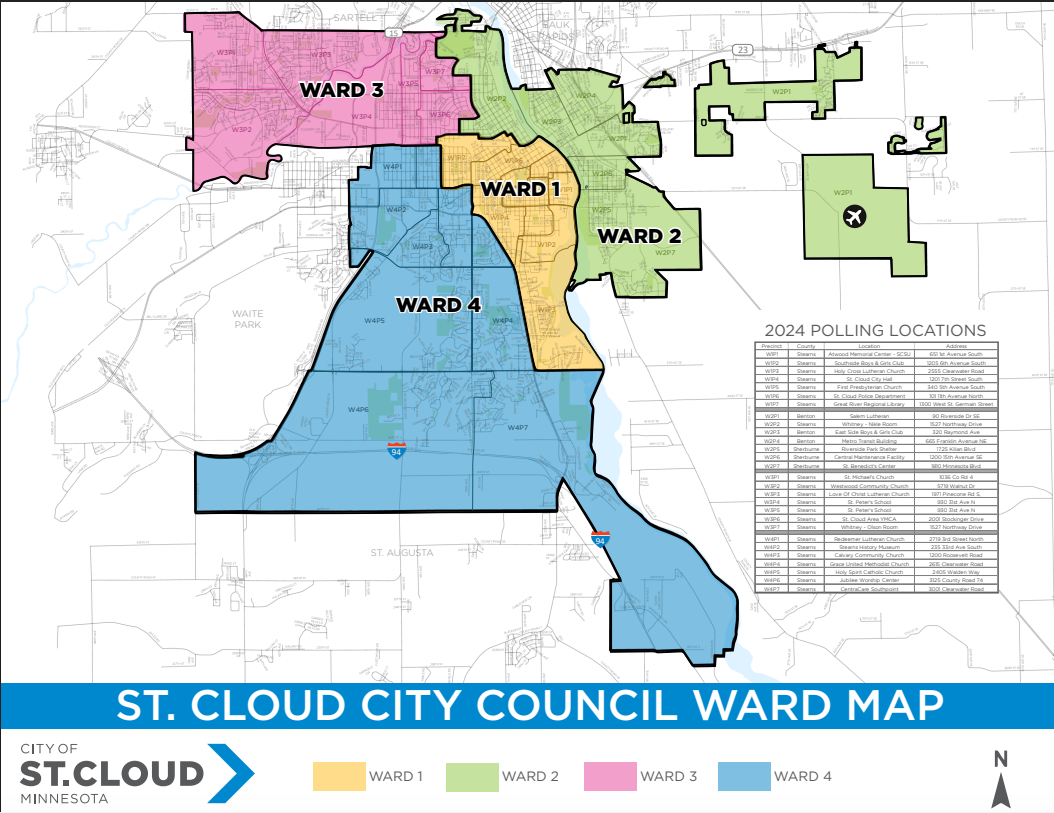
Map of wards and precincts in St. Cloud, MN - click to view full-sized PDF
The role of precincts in the DFL
As a unit of government, a precinct exists purely to administer elections. But within the DFL, the precinct is also an organizing unit — a defined geographic area used to coordinate party activity. Here, elections do happen. DFL members can run for precinct chair or precinct officer, roles that carry real responsibility for organizing neighbors, turning out caucus participants, and connecting the community to the party structure above it. It's a low-barrier entry point into formal party organizing, and most precincts have more room than they have people filling it.
Why precincts matters more than you'd think
Your precinct is where the organizing ladder starts. Every two years, Minnesota holds a precinct caucus. These neighborhood-level meetings are where DFL members gather to weigh in on the party's direction and select delegates to carry that voice forward.
At your caucus, you'll meet with your actual neighbors to elect precinct officers, discuss resolutions, and vote on items you want to see added to the party platform. Those resolutions move up through the delegate ladder alongside the delegates you elect, shaping what the DFL stands for at the senate district, congressional district, and state level.
On election night, precincts are also where results flow from. Poll workers at your polling place report results by precinct, and those numbers get aggregated up to the ward, city, county, and state level. When you watch election returns come in and see results by geography, precincts are the underlying unit making that possible.
How to find yours
The Minnesota Secretary of State's office has a polling place finder at mnvotes.gov. Enter your address, and it will tell you your polling place, your polling hours, and your precinct number.