
Senate District 14
Frequently Asked Questions
Politics Shouldn’t Be Confusing
But we know it can be.
If you're new to Minnesota politics — or just new to getting involved — welcome. This page covers the essentials, so you can spend less time confused and more time engaged.
In this FAQ, we'll cover:
What is the DFL?
DFL stands for Democratic-Farmer-Labor Party, Minnesota's affiliate of the national Democratic Party. The name comes from a 1944 merger between the Minnesota Democratic Party and the Farmer-Labor Party, a coalition of industrial workers and rural farmers who felt the major parties weren't representing their economic interests.
For the full history and structure of the party, read What is the DFL?
DFL party structure
How is the Minnesota DFL party structured?
The DFL is organized at three levels: local, congressional district and state. At the local level, there are 121 Organizing Units OUs), each built from the voting precincts within their boundaries. These OUs are spread across Minnesota's eight congressional districts. At every level, the party is governed by elected officers and committees. For a deeper look at how the party is organized and where SD14 fits within it, read What is the DFL?
What is an Organizing Unit?
An Organizing Unit (OU) is the local building block of DFL party organization. It exists at the level above the individual precinct — its boundaries may follow a county, a senate district, or a house district, depending on geography and population. SD14 DFL is the Organizing Unit for Senate District 14.
Who leads an Organizing Unit?
Each Organizing Unit elects a set of officers at its convention. Here's what each role is responsible for:
Chair — Convenes the unit's convention, presides at Central and Executive Committee meetings, and represents the unit at state and congressional district Central Committee meetings.
Vice Chair — Steps in for the Chair when needed and attends the same Central Committee meetings.
Secretary — Keeps minutes and attendance records for all committee meetings, notifies members of upcoming meetings, and maintains organization rosters.
Treasurer — Manages the unit's finances, ensures no funds are disbursed without proper authorization, and files required reports with the Minnesota Campaign Finance and Public Disclosure Board.
Outreach Officer — Leads outreach to underrepresented groups within the district, builds community relationships, and organizes voter registration drives.
Directors — Take on specific functions assigned by the Executive or Central Committee, such as fundraising, event planning, volunteer recruitment, and communications.
Most Organizing Units also elect State Central Committee Members and Alternates, who represent the unit at the statewide level.
Are DFL organizers paid?
The overwhelming majority of DFL officers and organizers — from precinct chairs to Organizing Unit officers to convention delegates (to the people who maintain local OU websites…) — are unpaid volunteers! These are your neighbors, coworkers, and community members who give their time because they care about their district and their state. The DFL's ability to organize, endorse candidates, and turn out voters depends almost entirely on that volunteer base.
If you're wondering what it looks like to get involved, What Does a Campaign Volunteer Do? walks through the roles and what to expect.
DFL party platform
What is a party platform?
The DFL platform is the official statement of the party's values and policy positions. It covers issues ranging from education and healthcare to housing and workers' rights. Unlike a candidate's campaign platform, the party platform is built from the ground up.
How does the DFL decide what's in the platform?
The process starts at the precinct caucus, where attendees vote on which resolutions to send forward. Those resolutions move up through the Organizing Unit convention, the Congressional District convention, and finally the State DFL Convention, where the platform is officially set. Every statement in the platform has received at least 60% of the delegate vote at the State Convention. For a closer look at how that process works, read What is the DFL?
What is the current DFL platform?
The 2026–2028 platform was adopted at the State DFL Convention in late May 2026. Read the full Minnesota DFL Ongoing Platform (we will update this link to the 2026 platform once it is published in July).
How do I vote?
Voting in Minnesota is straightforward, and the state makes it easy to find everything you need in one place. The Minnesota Secretary of State's Elections and Voting page is the authoritative source for:
Minnesota has some of the most accessible voting laws in the country, including same-day voter registration, early voting, and no excuse absentee voting.
For a full walkthrough of your early voting options for the 2026 primary election, read Voting Early in Minnesota's August Primary.
What's the difference between a primary and a general election?
Minnesota holds two separate elections in most election years. They serve different purposes and have different rules.
A primary election narrows the electoral field. Candidates from the same party compete against each other, and the winner advances to the general election. In Minnesota, the primary is open — you don't have to be registered with a party to vote, but you do choose one party's ballot.
A general election is the main event. Candidates from different parties face off, and the winner takes office. In Minnesota, the general election is always the first Tuesday after the first Monday in November. In 2026, that's November 4.
Primary turnout in Minnesota is typically a fraction of general election turnout, which means a relatively small number of voters often determine who appears on the November ballot. For our communities to have true representation, we need to encourage one another to vote in primary elections, too.
How does a bill become a law in Minnesota?
A bill starts as an idea — from a constituent, an advocacy group, a state agency, or a legislator — and has to clear several hurdles before it becomes law. It's introduced in either the House or Senate, assigned to committee, debated and amended, voted on by the full chamber, then sent to the other chamber to go through the same process. If both chambers pass different versions, a conference committee works out a compromise. The final version goes to the Governor, who can sign it, veto it, or let it become law without a signature.
In practice, most bills don't make it through. Committee deadlines, leadership priorities, and the end-of-session crunch shape what passes as much as the merits of any individual bill.
For the full walkthrough — including how to track a bill and how to contact your legislators while it's moving — read How a Bill Becomes a Law in Minnesota.
What is a precinct caucus?
A precinct caucus is a neighborhood meeting where DFL members gather to participate in the party-building process. It's the entry point for almost everything else in this FAQ — electing precinct officers, sending delegates to conventions, and passing resolutions that can eventually become part of the party platform.
Caucuses are held every two years, in the winter before a major election cycle. Attendance is open to any eligible voter who lives in the precinct and considers themselves a member of the DFL — even if the precinct caucus is their very first political experience!
There's no penalty for skipping a caucus, and your ability to vote in the primary or general election isn't affected by whether you attend. But, if you want a say in who the DFL endorses, who leads the party locally, or what the party stands for, the caucus is where that process starts.
For more on how precincts work and what they mean for local organizing, read What Is a Precinct?
Precinct caucus roles: what does each position do?
Every person who steps into one of these roles is volunteering their time to build the DFL from the ground up, and it matters.
Delegate — You and your fellow delegates represent your precinct at the District Convention. There you'll consider endorsing local candidates like state representatives and state senators, elect leaders to run the Organizing Unit, and elect delegates and alternates to the Congressional District and State Conventions.
Alternate delegate — Attend the District Convention as well. If a delegate can't make it, you'll step in to represent the precinct in their place.
Precinct Chair — This is a two-year commitment and the most hands-on local role in the DFL. As the DFL's point of contact within your neighborhood, you'll attend monthly Central Committee meetings at the SD14 DFL office. Keep an eye on the SD14 DFL calendar for meeting times and locations.
Precinct Chair responsibilities include:
Communicating with caucus participants about DFL activities and events throughout the two-year cycle
Canvassing precinct residents to identify likely DFL voters
Identifying DFL voters willing to volunteer on campaigns or host lawn signs
Facilitating voter registration efforts in the precinct
Distributing the DFL sample ballot and literature for endorsed candidates
Supporting get-out-the-vote efforts at election time
Vice Precinct Chair — You'll step in for the Precinct Chair if they can't attend an event or complete their term. Your commitment is also two years.
If you were elected to a precinct role in SD14, or would like to volunteer for a role, reach out to us directly.
Who are my current elected representatives?
Your elected representatives depend on where you live. Minnesotans are represented at the federal level by two U.S. Senators and one U.S. Representative, and at the state level by one State Senator and one State Representative. You may also have elected county commissioners, city council members, and school board members depending on your address.
The fastest way to find all of your representatives in one place is the Minnesota Secretary of State's Poll Finder tool. Enter your address and it will show your precinct, your districts, and your current elected officials at every level.
For a plain-language guide to which level of government controls what — and which elected officials to contact about which issues — read Who Runs What? Sorting Out Federal, State, and Local Offices.
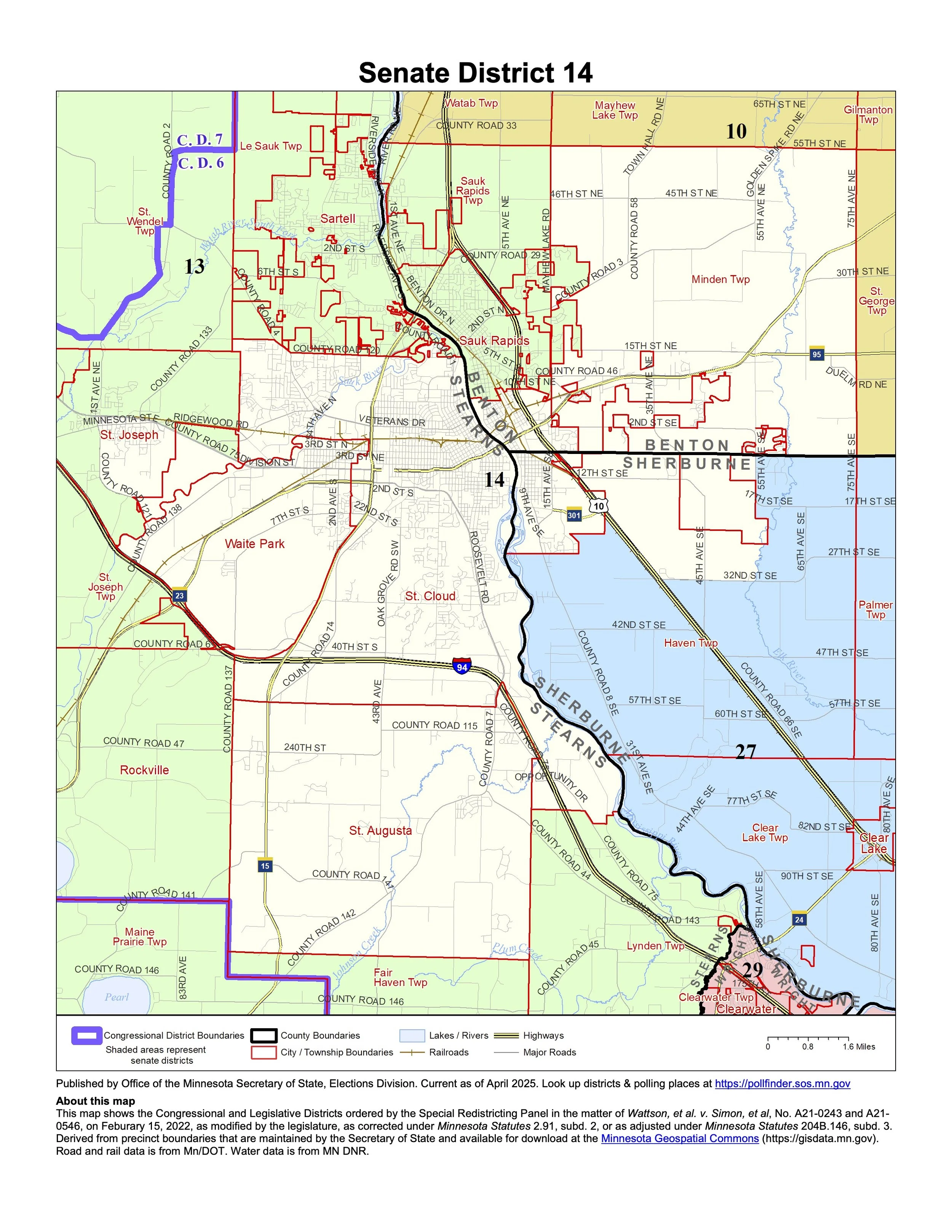
What is Senate District 14, and where is it?
Senate District 14 is one of 67 state legislative districts in Minnesota. Each senate district is represented by one state senator and contains two house districts, each represented by one state representative. SD14 covers a large geographic area in central Minnesota, including St. Cloud and surrounding communities in Stearns, Benton, and Sherburne counties.
To confirm whether you live in SD14, use the Minnesota Secretary of State's Poll Finder tool. Enter your address and look for your Senate District under Precinct & Districts.
The most current SD14 boundary map is available directly from the state — download the PDF here.
For more on what a senate district is and how it functions as a unit of both government and political organizing, read What Is a Senate District?
How do I get involved with SD14 DFL?
There are several ways to help out, depending on how much time you have and what you're good at.
The most direct path is through our Volunteer page, where you can sign up to hear about upcoming opportunities volunteering with the DFL or a campaign. Volunteering doesn't require any prior experience — there are roles for every skill level, from data entry and phone banking to canvassing and event support.
If you want to take on a more ongoing role in the party itself, attending a precinct caucus is where that starts. Caucuses are held every two years and are open to any eligible voter in the precinct who considers themselves a DFL member.
You can also stay connected by following us on Facebook, Instagram, or TikTok, checking the SD14 DFL calendar for upcoming events, and reading the blog for regular updates.
For a full breakdown of volunteer roles and what each one actually involves, read What Does a Campaign Volunteer Do?