How a bill becomes a law in Minnesota
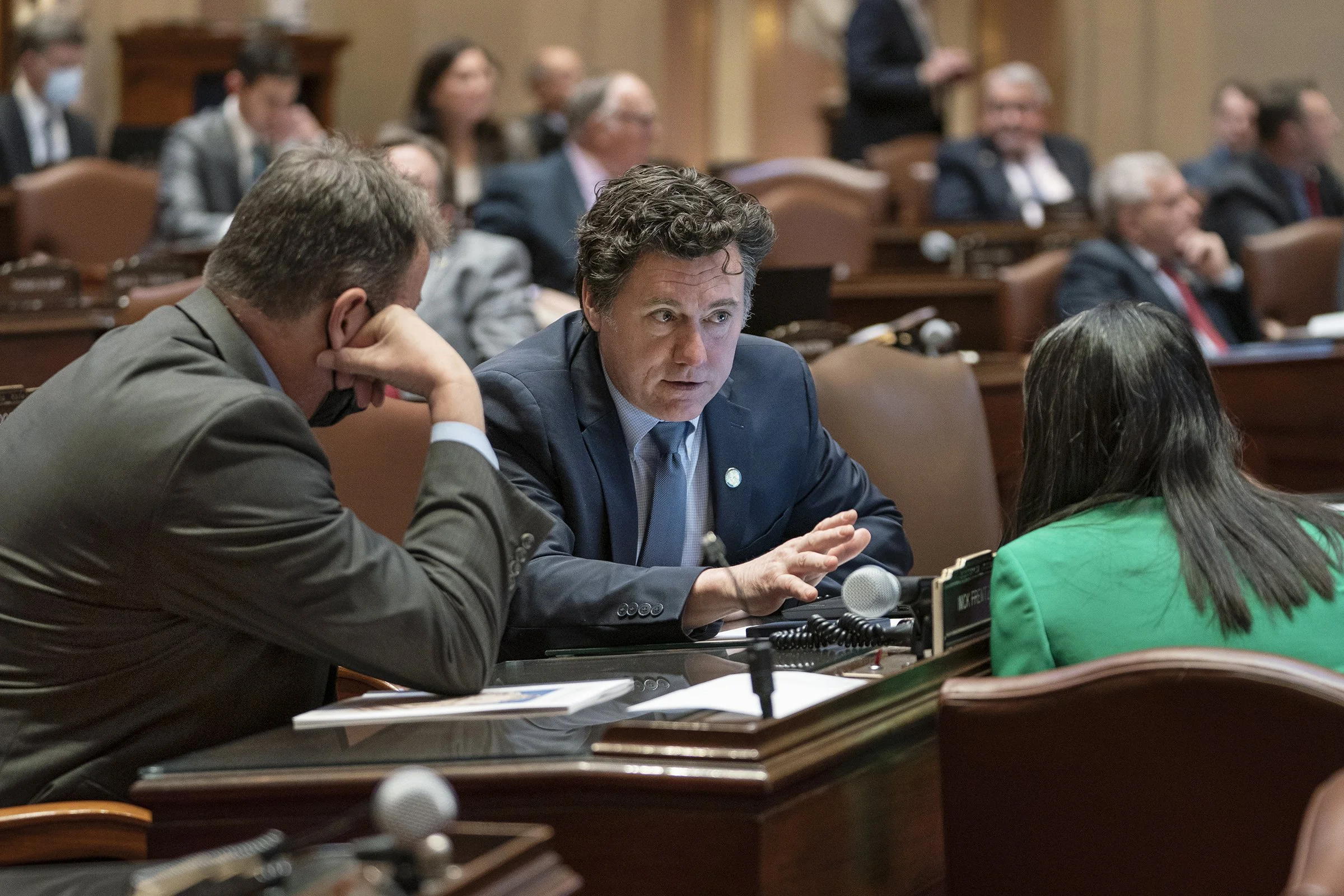
Sen. Aric Putnam (D-St. Cloud) discusses matters with colleagues on the Senate floor during session. Catherine Davis, Senate Media Services
What’s covered in this post:
How bills get introduced in Minnesota
How the committee process works
Deadlines in the Minnesota legislature
What happens when the House and Senate pass different versions
The governor's role
How and when to engage as a constituent
When a bill passes in Minnesota, the news covers the vote. What it usually skips is everything that happened before: the committee hearings, the amendments, the procedural deadlines, and the negotiations that shape whether a bill ever reaches a floor vote at all. Each of those stages has its own rules, its own gatekeepers, and its own pressure points.
Understanding this process drives home the importance of who you elect to represent you in office.
How a bill gets started
Legislation in Minnesota can originate from almost anywhere, but the path from idea to introduced bill follows a specific set of steps.
Where ideas for bills come from
A bill can start with any number of sources:
A legislator's own research
Constituent complaints
A state agency
Advocacy organizations
Businesses
Nonprofits
School districts
City councils
Lobbyists
What matters for the bill's fate is less where the idea came from and more whether the legislator introducing it has the standing and relationships to move it through committee.
Who your legislator listens to is just as important than what they say.
How a bill gets introduced in Minnesota
A bill can be introduced in the House, the Senate, or both chambers simultaneously. When identical or nearly identical bills are filed in both chambers at the same time, they're called companion bills — a common strategy to advance legislation on a parallel track and signal broader support.
Once introduced, the bill is assigned a number (HF for House File, SF for Senate File) and referred to one or more committees based on subject matter. That referral is the first real gate.
How committees work in the Minnesota legislature
Committees are where most bills are won or lost. A bill that never gets a hearing never gets a vote, and whether a bill gets a hearing is largely up to one person.
The committee chair holds a great deal of power
Each committee is chaired by a member of the majority party, and that chair controls the hearing schedule. The Minnesota Legislature's structure overview lists all active committees and their current chairs. If the chair doesn't schedule a hearing on a bill, the bill goes nowhere. It doesn’t even get taken up for debate. This is one of the most consequential and least covered aspects of the legislative process. It's also why majority control of a chamber matters so much beyond the floor vote count.
What happens at a committee hearing
When a bill does get a hearing, the committee can:
Take testimony from the bill's author, agency representatives, and members of the public
Propose and vote on amendments
Vote to advance the bill, table it, or kill it
Many bills are referred to more than one committee, meaning this process repeats. A bill might clear its first committee only to stall in the second. Each stop is a separate vote, a separate hearing, and a separate opportunity for the bill to be amended or blocked.
Legislative deadlines and how they shape the session
The Minnesota Legislature operates on a strict deadline structure set by a concurrent resolution passed at the start of each session. A few mechanics worth knowing:
A legislative day is a day the chamber is officially in session; this is not the same as a calendar day
Committee deadline is the date by which bills must clear committee to remain eligible for a floor vote
Bills that miss the deadline are done for that session unless they're attached to another vehicle, like an omnibus bill
The Minnesota Legislature's bill tracking tool shows where any bill stands in the process at any point in the session.
When the House and Senate disagree
The Minnesota Legislature has two chambers, and both have to pass a bill before it goes to the governor. When they pass different versions, the bill doesn't automatically fail, but it does have to go through one more round.
How conference committees resolve differences
When the House and Senate pass different versions of the same bill, legislative leaders from both chambers appoint a conference committee to work out a single version. Conference committees are small — typically three to five members from each chamber — and their negotiations happen outside the normal committee hearing process. The resulting compromise language goes back to both chambers for an up-or-down vote. No amendments can be added at that stage. Members vote on the conference report as written.
The governor's role after a bill passes
Once both chambers pass identical language, the bill goes to the governor, who has several options:
Sign it into law
Veto it, sending it back to the Legislature
Allow it to become law without a signature after three days during session, or after fourteen days after adjournment
For budget and spending bills, use the line-item veto to strike specific appropriations while signing the rest
A veto can be overridden, but the threshold is high: two-thirds of both chambers must vote to override. In practice, overrides are rare. The governor's veto is a meaningful check on the Legislature, and the override threshold means it usually holds.
How to engage with the legislative process
Knowing the structure of the process points you toward where public engagement actually has an impact. Most of it happens earlier than people think.
Why the committee stage is the most important pressure point
By the time a bill reaches a floor vote, the outcome is usually set. The real window for influence is during committee — before a bill is advanced, amended, or set aside. Three ways to engage at that stage:
Contact your legislators directly. A phone call or email to your state representative or senator carries more weight during committee deliberations than after a floor vote. You can find your Minnesota legislators by address.
Submit or deliver testimony. Most committee hearings accept written testimony from the public, and some allow in-person testimony. The Minnesota Legislature's committee schedule lists upcoming hearings.
Show up. Committee hearings are open to the public. Attendance is noticed, especially on contested bills.
If you're new to how Minnesota government is structured, Who runs what? Sorting out federal, state, and local offices and What is a senate district? are good starting points.
Practical ways to follow and engage with Minnesota legislation
A few resources that make it easier to track what's moving through the legislature and who represents you:
Minnesota Legislature bill tracking — search any bill by number, topic, or author; see its current committee status
Find your legislators — enter your address to get your House and Senate representatives with contact information
Minnesota Legislature FAQ — plain-language answers to common questions about how the process works
SD14 DFL events calendar — upcoming local events where you can learn more and get involved
The Minnesota Legislature's process is designed to be deliberate. That creates a lot of points where a bill can be slowed, changed, or stopped. That's also what makes the earlier stages worth paying attention to.
If you want to understand why a law looks the way it does, or why a bill you cared about didn't pass, the committee record usually has the answer. The Minnesota Legislature's bill tracking toolis the fastest way to follow any bill from introduction to outcome.